Without a doubt, the most important way to style a Bonsai is to prune it regularly. There are two different techniques: maintenance-pruning, to maintain and refine the existing shape of a Bonsai, and structural-pruning, which involves more rigorous pruning to give a tree its basic shape.
Before discussing both techniques in more detail, it’s helpful to get a bit more fundamental information on how trees grow. This will help us understand how to prune Bonsai trees efficiently.
Trees have a natural tendency to grow with apical dominance. This means that the main, central stem of the plant grows more dominantly than its side stems. For example, on a branch, the main stem of the branch is more dominant over its side twigs. This natural mechanism encourages trees to grow higher to prevent them from being shaded out by competing trees. By distributing growth to the top and outer edges, the tree’s inner and lower branches will eventually die, while top branches grow out of proportion, both of which are not desirable traits for Bonsai aesthetics.
Knowing the natural growth patterns of trees tells us how we can use pruning techniques to counter the effects of apical dominance. Because dominant growth occurs on a trees’ central stems, we know we have to prune the top and outer portions of a tree more thoroughly. This forces the tree to redistribute growth to the inner and lower parts, which gives us control over the growth and design of the tree.
Maintenance pruning a Ficus Bonsai. We maintain the shape of this tree by pruning regularly, which will also result in finer growth and a dense canopy.
Bonsai maintenance pruning
The goal of maintenance pruning is to maintain and refine the shape of a tree. As explained above, trees will concentrate most growth on the top and outer parts of its stems; it is important to prune these growth areas regularly to encourage growth closer to the inner parts of the tree.
Pruning a pine (incorrect) Pinching by hand (correct)
Structural Bonsai pruning
Giving a tree its basic shape often involves pruning large branches. Deciding on which branches should stay and which ones should be removed can be a difficult choice. Not only because it is an irreversible action but also because it will define how the tree will look. Before rushing into techniques used for pruning Bonsai trees, we recommend taking a look at the Progressions section. You‘ll find great references and examples of experienced Bonsai artists structure-pruning nursery stock.
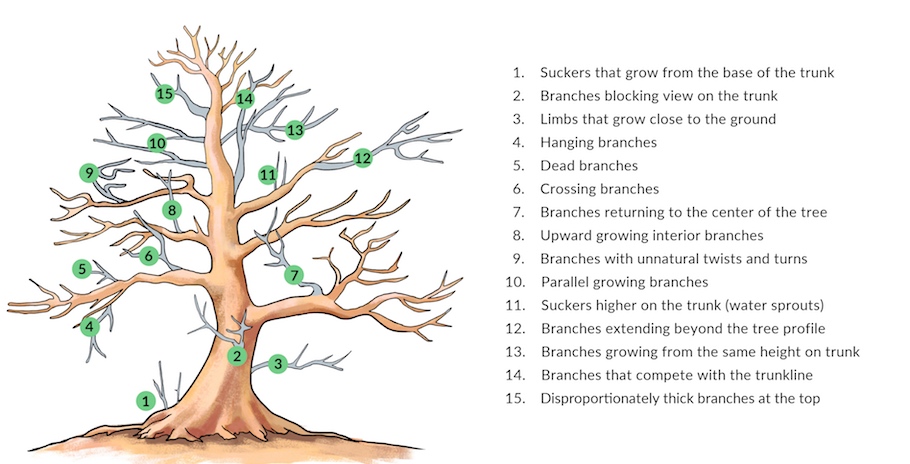
Pruning a Bonsai tree illustration; grey branches can be removed. Ultimately, pruning is not about following strict rules, but about establishing the best design for your tree. This illustration only serves to provide some general guidelines.
Pruning thick branches typically result in ugly scars but by using special concave cutters you can reduce scaring effects significantly. We advise sealing large wounds with cut paste, available at most online Bonsai shops. The paste protects the wounds from infections and helps the tree to heal faster. Again, using the right Bonsai tools will help significantly.
A healthy tree should have no problem coping with the pruning of up to 1/3 of its foliage. Some say you should cut/remove an equal percentage of roots after a tree has been styled. However, most experts advise only performing one big maintenance at a time (or even once a year). For example, if you structure-prune this spring, you should wait to do any repotting or root cutting until the next spring when the tree has fully recovered from the structure-pruning. Take a look at the Surface roots page for more details on pruning roots.
Master the art of Bonsai
Overview of our courses
Master the art of Bonsai
Online Bonsai CoursesLearn from leading Bonsai experts at your own pace, from the comfort of your living room!
This Ficus needs to be pruned, as several long shoots have grown out of shape.
2
Prune long shoots using a Twig shear.
3
In this case, we’ve removed about 20% of all leaves.
4
Pruned material.
5
When pruning larger branches, we use a concave cutter. In this photo, you see the shape of the cutter which leaves a hollow wound that heals faster than flat wounds.
6
Create some space to cut, by pruning the majority of the branch first.
7
Now that the majority of branches are removed, you have space to make a clean cut exactly where we want to.
8
We cover the hollow wound with cut paste, which will help the wound heal quicker.
9
We use a Japanese brand of cut paste, but you can select any brand you like.
10
The wound, covered with cut paste.
Key take-away
Maintenance pruning can be done year-round, but you should only perform structural-pruning once a year, in the spring or fall.